Friday, 26 October 2012
Animation about Time
Professor Philip Zimbardo conveys how our individual perspectives of time affect our work, health and well-being. Time influences who we are as a person, how we view relationships and how we act in the world
Whilst looking up other animations about time I came across this animation. Very simple technique, but relays information to the audience very clearly and effectively - as the story is drawn it forms a mind map.

Thursday, 25 October 2012
Ludology vs. Narratology debate
"This disagreement has been called the ludology vs. narratology debates. The narratological view is that games should be understood as novel forms of narrative and can thus be studied using theories of narrative (Murray, 1997; Atkins, 2003). The ludological position is that games should be understood on their own terms. Ludologists have proposed that the study of games should concern the analysis of the abstract and formal systems they describe. In other words, the focus of game studies should be on the rules of a game, not on the representational elements which are only incidental (Aarseth, 2001; Eskelinen, 2001; Eskelinen, 2004). The idea that a videogame is “radically different to narratives as a cognitive and communicative structure”[8] has led the development of new approaches to criticism that are focused on videogames as well adapting, repurposing and proposing new ways of studying and theorizing about videogames.[9][10] A recent approach towards game studies starts with an analysis of interface structures and challenges the keyboard-mouse paradigm with what is called "ludic interfaces"."
http://en.wikipedia.org/wiki/Game_studies
This passage, describes the different practices that have emerged in the study of games. Games have only been around since the early 1970's. There are claims that the games industry surpasses that of the film industry, this claim would suggest that the audience for games is greater than that for film. However, according to kristen thompson, the games industry combines sales of software (games) with hardware (consoles, accessories) in its figures, whereas film only show figures relating to sales of 'software' (films sales and rentals. This would not include sales of DVD players, consoles etc.) So with all 'hardware' removed from this equation, the games industry will account to half of the film industries total sales globally.
http://gamepolitics.com/2010/12/28/games-v-movies-numbers#.UIkeLcUmdAM

The earliest recorded video game was created by William Higinbotham, 1958. Claims that an earlier game was created 1948, almost 10 years earlier by Thomas t. Goldsmith Jr. and Estle R. mann, who patented their game "Cathode-Ray Tube Amusement Device". However, the player was required to place pictures/illustration onto the screen, whereas Higinbotham's game which displayed its visuals on the screen.
The game was played on a brookhaven national laboratory oscilloscope. Players queued up to play.
"Tennis for two"
"Tennis for Two was first introduced on October 18, 1958, at one of the Lab’s annual visitors’ days."
"Higinbotham realized how static and non-interactive most science exhibits were at that time. As head of Brookhaven Lab’s Instrumentation Division, he would change that. While reflecting on his creation, Higinbotham wrote, “it might liven up the place to have a game that people could play, and which would convey the message that our scientific endeavors have relevance for society."
http://www.bnl.gov/bnlweb/history/higinbotham.asp
The earliest games created were built with one function, with no narrative whatsoever, and still were successful as games. As games developed and graphics, functionality and networking has become more complex across this medium, games are being recognized by narratologists as a medium for story and narration.
Games such as Zelda, Final fantasy and Assassins creed could all be considered story driven games. All are extremely successful, but the same can be said for games like Mario brothers, Sonic the hedgehog and street fighter. Its difficult at this point to really know what it is about these games that make them so successful. Some clear parameters need to be made on arguments made by:
http://en.wikipedia.org/wiki/Game_studies
This passage, describes the different practices that have emerged in the study of games. Games have only been around since the early 1970's. There are claims that the games industry surpasses that of the film industry, this claim would suggest that the audience for games is greater than that for film. However, according to kristen thompson, the games industry combines sales of software (games) with hardware (consoles, accessories) in its figures, whereas film only show figures relating to sales of 'software' (films sales and rentals. This would not include sales of DVD players, consoles etc.) So with all 'hardware' removed from this equation, the games industry will account to half of the film industries total sales globally.
http://gamepolitics.com/2010/12/28/games-v-movies-numbers#.UIkeLcUmdAM

The earliest recorded video game was created by William Higinbotham, 1958. Claims that an earlier game was created 1948, almost 10 years earlier by Thomas t. Goldsmith Jr. and Estle R. mann, who patented their game "Cathode-Ray Tube Amusement Device". However, the player was required to place pictures/illustration onto the screen, whereas Higinbotham's game which displayed its visuals on the screen.
The game was played on a brookhaven national laboratory oscilloscope. Players queued up to play.
 |
| William Higinbotham |
"Tennis for two"
"Tennis for Two was first introduced on October 18, 1958, at one of the Lab’s annual visitors’ days."
"Higinbotham realized how static and non-interactive most science exhibits were at that time. As head of Brookhaven Lab’s Instrumentation Division, he would change that. While reflecting on his creation, Higinbotham wrote, “it might liven up the place to have a game that people could play, and which would convey the message that our scientific endeavors have relevance for society."
http://www.bnl.gov/bnlweb/history/higinbotham.asp
It wasn't until 1962 the first game created for the computer, by Steve Russell, who created the game 'spacewars'. The aim of the game was to shoot obstructions/ asteroids in space.
http://inventors.about.com/library/inventors/blcomputer_videogames.htm
http://inventors.about.com/library/inventors/blcomputer_videogames.htm
The earliest games created were built with one function, with no narrative whatsoever, and still were successful as games. As games developed and graphics, functionality and networking has become more complex across this medium, games are being recognized by narratologists as a medium for story and narration.
Games such as Zelda, Final fantasy and Assassins creed could all be considered story driven games. All are extremely successful, but the same can be said for games like Mario brothers, Sonic the hedgehog and street fighter. Its difficult at this point to really know what it is about these games that make them so successful. Some clear parameters need to be made on arguments made by:
- Ludologists
- Narratologists
Both parties have clear ideas on what makes a game successful and what games purposes have within society today.
With that in mind I will then look at the purposes of a game (games meaning any board game, book, video etc. and key devices that are specific to games) and then the purpose of a story and the devices that make a story successful (or unsuccessful). I'll be able to compare the two forms, and hopefully find a formula that shows how these two mediums can be combined.
Ludology
etymology: 'Ludo' latin for game, ludology simply means the study of games, particularly of board games, until recently as games have developed.
Though ludology would include video game theory, it goes beyond this as this area of study includes ALL games. It takes a formal approach to the study of games and its place in media ecology.
http://www.ludology.org/2001/07/what-is-ludolog.html
David Jaffe, creator of the game 'God of War', believes stories in video games is a set back and claims this has even stunted the development of video games.
"Jaffe claimed the industry has mistakenly focused on storytelling since the early 90s, and elaborated in a recent interview, "I think with...the advent of CDs for game storage, and then high end graphics and voice actors and all this -- cutscenes -- games kind of got off on a bit of a wrong track that was very appealing, but it wasn't necessarily the only track we should have got off on. And I think that's what the lesson taught me" - Gamesutra
http://www.1up.com/news/god-war-creator-calls-story
Narratology
narratology is primarily the study and representation of narrative within literature, film and digital media.
http://www.narratology.net/
narratologist Stephen Dinehart, founder of the Narrative Design Explorer, which combines lugology, narratology and game design to create interactive storytelling or a term he coined as 'transmedia storytelling'.
"He was final nominee for “Best Writing for a Game Production” for Company of Heroes: Opposing Fronts at the 2nd Annual Canadian Awards for the Electronic & Animated Arts(2007), and the game won “Nokia Award for Outstanding Innovation in Gaming."
http://en.wikipedia.org/wiki/Stephen_Dinehart
I will explore the purposes of games and narration in depth and compare later on for my own study and conclude my response on the ludology vs. narratology debate. I hope to identify the future for both practices within games, individually and combined.
Ludology
etymology: 'Ludo' latin for game, ludology simply means the study of games, particularly of board games, until recently as games have developed.
Though ludology would include video game theory, it goes beyond this as this area of study includes ALL games. It takes a formal approach to the study of games and its place in media ecology.
http://www.ludology.org/2001/07/what-is-ludolog.html
David Jaffe, creator of the game 'God of War', believes stories in video games is a set back and claims this has even stunted the development of video games.
"Jaffe claimed the industry has mistakenly focused on storytelling since the early 90s, and elaborated in a recent interview, "I think with...the advent of CDs for game storage, and then high end graphics and voice actors and all this -- cutscenes -- games kind of got off on a bit of a wrong track that was very appealing, but it wasn't necessarily the only track we should have got off on. And I think that's what the lesson taught me" - Gamesutra
http://www.1up.com/news/god-war-creator-calls-story
Narratology
narratology is primarily the study and representation of narrative within literature, film and digital media.
http://www.narratology.net/
narratologist Stephen Dinehart, founder of the Narrative Design Explorer, which combines lugology, narratology and game design to create interactive storytelling or a term he coined as 'transmedia storytelling'.
"He was final nominee for “Best Writing for a Game Production” for Company of Heroes: Opposing Fronts at the 2nd Annual Canadian Awards for the Electronic & Animated Arts(2007), and the game won “Nokia Award for Outstanding Innovation in Gaming."
http://en.wikipedia.org/wiki/Stephen_Dinehart
I will explore the purposes of games and narration in depth and compare later on for my own study and conclude my response on the ludology vs. narratology debate. I hope to identify the future for both practices within games, individually and combined.
Sunday, 21 October 2012
The zoo


Dodo


of these birds was exhibited in John
Tradescant’s London museum. His collections
were later left to Elias Ashmole and so came to
Oxford, where now only the mummified head
and foot remain. Although minimal, these
specimens represent the most complete
remains of a single dodo, and are of great
value to scientists today. "
"Fat or thin?
The best information about the dodo might be
expected to come from the people who saw the
bird in its native habitat. Unfortunately, most
of the written accounts tell us more about 17th
century attitudes to nature and the writers’
own concerns than they do about the dodo
itself. Images produced by some of the first
Europeans to visit Mauritius in 1598 showed
very thin birds. In a scene from Admiral Van
Neck’s account, a rather athletic dodo is
striding off into the distance. This is in
marked contrast to the fatter, European
representations."
http://www.oum.ox.ac.uk/learning/pdfs/dodo.pdf


http://en.wikipedia.org/wiki/Dodo
Saturday, 20 October 2012
Ian livingstone
Ian Livingstone, born 1949 in Cheshire, UK, is most known for co writing the adventure game stories and board games 'Dungeons and dragons'
Ian Livingstone is co founder of GAMES WORKSHOP with Steve Jackson and John Peake. The store was founded in 1975, crafting and selling board games, but with the success of 'Dungeons and dragons', the shop become the main distributer for Dungeons and dragons and publisher. They also published other stories they wrote, i.e. the 'Fighting Fantasy' book series
http://www.games-workshop.com/gws/home.jsp
In the interview below Livingstone describes how fans of the books are given the oppurtunity to create a phone app game using the Fighting Fantasy books.
http://www.fightingfantasy.com/
An observation from this: the devices used for game play will differ across different gaming platforms, e.g. books use chance to determine battle outcomes, computer games use the players skill to control the games protagonist. But all gaming outlets (i.e. books, computers, board games etc.) will have the aim of 'winning'.
The narratives in the 'Fighting Fantasy' allow the fundamental aspects of the game to be ported from one medium to the next and still remain the same game, simply played differently.
http://www.gamebasedlearning2009.com/conference/speakers/907-spekers/181-ian-livingstone-co-founder-eidos-chair-computer-games-skills-council-skillset-
http://en.wikipedia.org/wiki/Ian_Livingstone
Ian Livingstone is co founder of GAMES WORKSHOP with Steve Jackson and John Peake. The store was founded in 1975, crafting and selling board games, but with the success of 'Dungeons and dragons', the shop become the main distributer for Dungeons and dragons and publisher. They also published other stories they wrote, i.e. the 'Fighting Fantasy' book series
http://www.games-workshop.com/gws/home.jsp
In the interview below Livingstone describes how fans of the books are given the oppurtunity to create a phone app game using the Fighting Fantasy books.
http://www.fightingfantasy.com/
An observation from this: the devices used for game play will differ across different gaming platforms, e.g. books use chance to determine battle outcomes, computer games use the players skill to control the games protagonist. But all gaming outlets (i.e. books, computers, board games etc.) will have the aim of 'winning'.
The narratives in the 'Fighting Fantasy' allow the fundamental aspects of the game to be ported from one medium to the next and still remain the same game, simply played differently.
http://www.gamebasedlearning2009.com/conference/speakers/907-spekers/181-ian-livingstone-co-founder-eidos-chair-computer-games-skills-council-skillset-
http://en.wikipedia.org/wiki/Ian_Livingstone
Friday, 19 October 2012
Yuri Norstein
Textures to represent creatures. Different methods of characterization and representation in this animation form. The animals themselves are symbolic and the collage effect gives the characters some substance. There is little detail in the scenes and background, as it is set in a fog.
http://en.wikipedia.org/wiki/Yuriy_Norshteyn
"Yuri Norstein is widely regarded as one of the most innovative animators of all time. Born in Russia in 1941, his family were evacuated during WWII and taken to Moscow in 1943."
He created some 50 films before he had the chance to direct his own films.
http://www.acmi.net.au/yuri_norstein.htm
http://en.wikipedia.org/wiki/Yuriy_Norshteyn
"Yuri Norstein is widely regarded as one of the most innovative animators of all time. Born in Russia in 1941, his family were evacuated during WWII and taken to Moscow in 1943."
He created some 50 films before he had the chance to direct his own films.
http://www.acmi.net.au/yuri_norstein.htm
Designing animal characters
review of the book: http://www.goodreads.com/book/show/1446922.The_Art_Of_Animal_Character_Design
Richard Williams books 'Animators survival kit' has some great tips and things to look for when it comes to animating animals, in particular quadrupeds' (four legged animals).
A particular example he uses is 'does a horse walk like a man and an ostrich'.
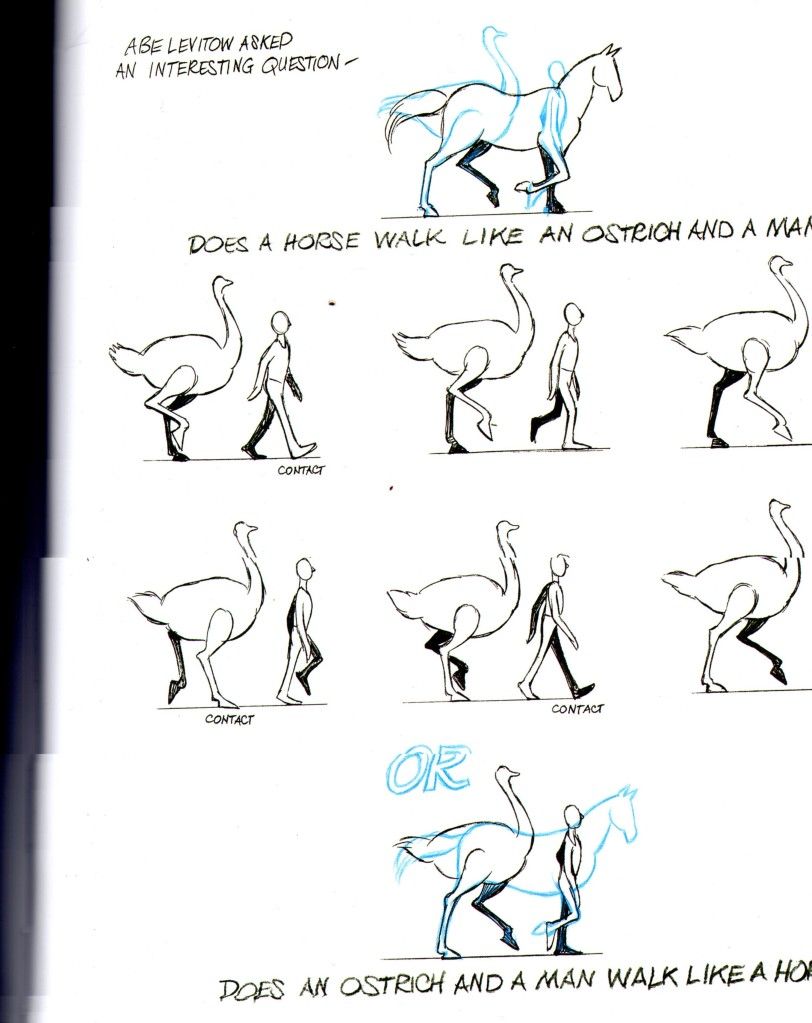
He also uses these types of diagrams to explain the walk cycles of a qaudrupeds, using a dog as an example. He explains how the muscles will squash and stretch as the dog lifts its paws off the floor. Also the tertiary movements of the legs and the body (the shoulders follow the movement of the leg as the dig walks forward.)

Most animation practitioners, in any principle, have found the Muybridge collections to be some of the most useful references for studying movement of people and animals.


This is a character sheet of the horse character from the Disney film 'Mulan'. The design of the character does well to represent the horse through its form, but has stylized the character through the use of full round shapes. This adds weight to the character and overall gives it an appealing quality.

Richard Williams books 'Animators survival kit' has some great tips and things to look for when it comes to animating animals, in particular quadrupeds' (four legged animals).
A particular example he uses is 'does a horse walk like a man and an ostrich'.


Most animation practitioners, in any principle, have found the Muybridge collections to be some of the most useful references for studying movement of people and animals.


Subscribe to:
Posts (Atom)