Textures to represent creatures. Different methods of characterization and representation in this animation form. The animals themselves are symbolic and the collage effect gives the characters some substance. There is little detail in the scenes and background, as it is set in a fog.
http://en.wikipedia.org/wiki/Yuriy_Norshteyn
"Yuri Norstein is widely regarded as one of the most innovative animators of all time. Born in Russia in 1941, his family were evacuated during WWII and taken to Moscow in 1943."
He created some 50 films before he had the chance to direct his own films.
http://www.acmi.net.au/yuri_norstein.htm
Friday, 19 October 2012

Designing animal characters
review of the book: http://www.goodreads.com/book/show/1446922.The_Art_Of_Animal_Character_Design
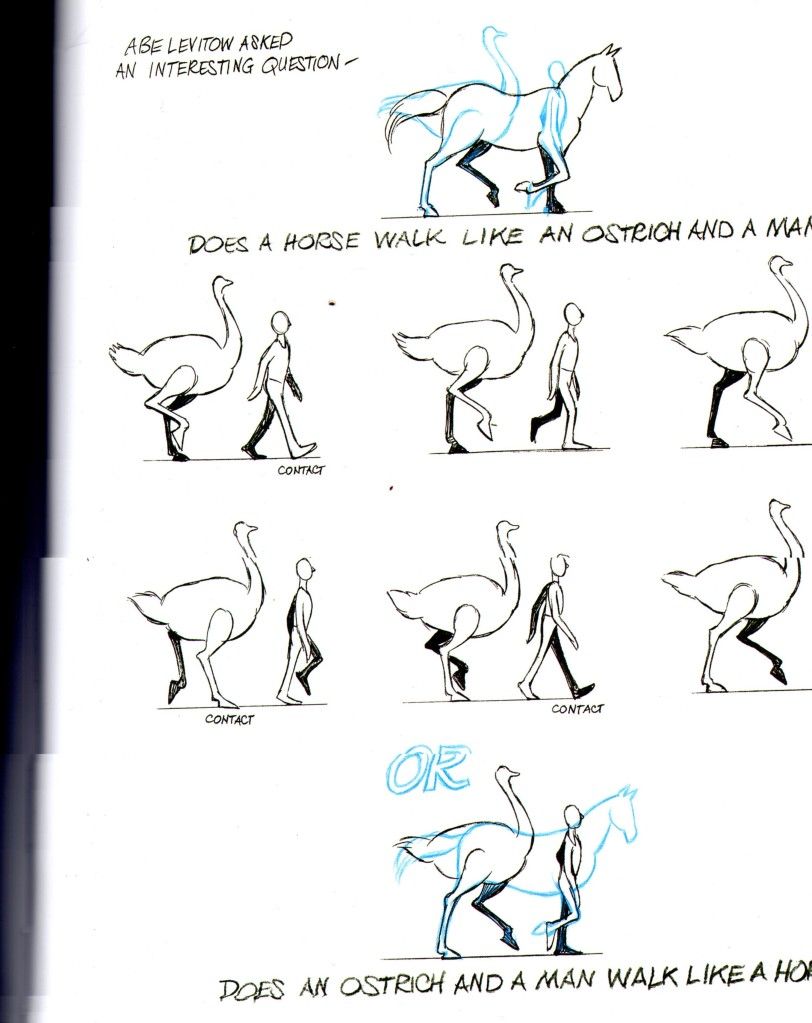
Richard Williams books 'Animators survival kit' has some great tips and things to look for when it comes to animating animals, in particular quadrupeds' (four legged animals).
A particular example he uses is 'does a horse walk like a man and an ostrich'.
He also uses these types of diagrams to explain the walk cycles of a qaudrupeds, using a dog as an example. He explains how the muscles will squash and stretch as the dog lifts its paws off the floor. Also the tertiary movements of the legs and the body (the shoulders follow the movement of the leg as the dig walks forward.)

Most animation practitioners, in any principle, have found the Muybridge collections to be some of the most useful references for studying movement of people and animals.


This is a character sheet of the horse character from the Disney film 'Mulan'. The design of the character does well to represent the horse through its form, but has stylized the character through the use of full round shapes. This adds weight to the character and overall gives it an appealing quality.

Richard Williams books 'Animators survival kit' has some great tips and things to look for when it comes to animating animals, in particular quadrupeds' (four legged animals).
A particular example he uses is 'does a horse walk like a man and an ostrich'.


Most animation practitioners, in any principle, have found the Muybridge collections to be some of the most useful references for studying movement of people and animals.


Extinct animals
Here is a list of animals that are now extinct. I'l be studying creatures and developing my understanding of the principles to animating animals, so I can apply these to animate the extinct animal characters for this project.


http://www.oddee.com/item_88742.aspx list of odd extinct animals
http://animal.discovery.com/tv/a-list/creature-countdowns/extinct/extinct.html useful list of well known extinct animals


GAME NARRATIVE - intro
I am really interested in game narrative, and have wondered what types of prospects or opportunities this creates for games and their future.
This requires some research on what a narrative is and its different forms. I'll be looking into games writers, such as Ian Livingstone who creates games like the adventure game books, along with his partner Steve Jackson.
Also the most successful game series to create story driven games, Final Fantasy series. I'll have a look at the most successful and the least. I'll have to determine the criteria for this. I'l use this case study of the Square Enix's 'Final Fantasy' series to determine this:

Case study

Final fantasy VII - as a game that integrates story with world exploration and character interaction, most fans seem to agree this was one of square enix's best (developers) despite its limited graphics. The characters are some of this series strongest and most memorable, still to this day.
A book on game narrative, suggests the most important part of any stories is its characters and how they interact and communicate. Meaning the setting or location could change and not affect the overall story. This could explain why the story for this edition of the games series was considered so strong. Players could enjoy exploring the world whilst still being able to understand a complex story line through the strength of its characters. The exploration and interaction with the world was used to enhance the complex story line with the growth of the characters and their relationships.
compared to

Final Fantasy XII - This edition of the series took the game in new directions with its games mechanics and battle systems. It was successful in this and most regulars to the series congratulated its new timed battle systems (the prequels had always been turn based before) setting a new precedent for the series to the flow of the game play . However, its story line was much shorter and far less epic than the fans were used to. Therefore in this sense, it was considered a good game but its lack of narrative made it less successful, as its audience expect a more entertaining or engrossing narrative.

Final Fantasy XIII - The writer (Motomu Toriyama) for this edition of the series, had noted that its predecessor had been condemned by fans for the less than epic narrative. In an interview he declared that he felt narrative was the most important part of a game, and that exploration should be kept to a minimum for a game and its narrative to be successful. But when this was released fans found the story was fed to them through linear game play and little exploration.
 The narrative lived up to FF's usual promise, however, much to Toriyama's dismay, this was not received well when fans complained by the lack of exploration, and confusion over parts of the story as it was explained through long, drawn out (though magnificent) cut scenes. This is an effective method of portraying a narrative in films, but a typical game player would expect shorter cut scenes and to be able to learn parts of the story through exploration of the world and interaction with its characters. The audience for a game will have different expectations to those for a film. Toriyamas method of utilizing narrative through restricting game play this time seemed to be unsuccessful.

So for final fantasy games, it seems the criteria for this to be successful would be:
- Epic narrative - This is best utilized through strong characters. The relationships between these characters is the basis for the story.

http://en.wikipedia.org/wiki/Chuck_Lorre
- World exploration - The audience for games is much different to the audience for a film. This has to be recognized and one of the most popular aspects of the FF series its its exciting lands, people and creatures to find. Players enjoy being able to feel free to roam a virtual world. This perhaps makes the virtual world feel more like a real world. In the example, FF XIII tried restricting players with its linear paths, disallowing oppurtunity's to explore areas, with more emphasis on the cut scenes than exploring the world. This was an attempt to make the game into more of an 'interactive movie'.


Motomu Toriyama is a supporter and advocate of the "Interactive Movie RPG" game design created by Yoshinori Kitase and used in Final Fantasy X and Final Fantasy XIII.[6] Toriyama believes his strength is in directing games that are very story-driven.[10] He also believes that it becomes very difficult to tell a compelling story when the player is given a huge amount of freedom to explore.[9] According to him, the most important aspect of a Final Fantasy game is the characters.[11] Toriyama has stated that the aim of the game design used in the first half of Final Fantasy XIII was to feel like watching a film. The reason was so the player could become absorbed with the story and characters and not get distracted or lost
We can all agree the strength of a story is through its characters, yet the FF series has proved that exploration and game play can be used to tell and complex story. Toriyama's method of story-telling has been designed to be more like a film. It was the first game in the series to use motion control and HD, so its easy to understand why the aim was to produce a game of this caliber But as this is not what the audience expected this simply made it unsuccessful as a fantasy game.
- Current game devices and battle systems - This has been developed over the series, from turn based to timed, sequenced battle systems. The updates to these systems have improved the overall flow of the game, whilst keeping in tune with audience's expectation of strategic role playing games.
The success of the FF series seems to be on the ability to portray a complex story line. The importance of narrative in games has long been debated in the 'ludology v.s narratology debate'.
This disagreement has been called the ludology vs. narratology debates. The narratological view is that games should be understood as novel forms of narrative and can thus be studied using theories of narrative (Murray, 1997; Atkins, 2003). The ludological position is that games should be understood on their own terms. Ludologists have proposed that the study of games should concern the analysis of the abstract and formal systems they describe. In other words, the focus of game studies should be on the rules of a game, not on the representational elements which are only incidental (Aarseth, 2001; Eskelinen, 2001; Eskelinen, 2004).http://en.wikipedia.org/wiki/Game_studies
This links to blog of ludologist: http://www.jesperjuul.dk/ludologist/
In the case of FF XII suggested that this game was less successful than others in the series because of its lack of narrative. However it explored new game strategies in role playing games, which is important for a game to keep up to date in a rapidly changing and growing market. This will have to be explored more in the 'ludology vs. narrative' debate.
Friday, 12 October 2012
Hans Bacher - pre production artist

He has worked on the designs for many disney films, such as Mulan, Aladdin and beauty and the beast
In his book he explains the production process from how you go from doodles and sketch studies, to the finished polished animated film. pre production procedures:
Visual Research and development - Research for this can be extensive, Disney often allowing average 5 years for visual research before creating an animated film. Looking for inspiration.
Scene design storyboards- he explains aspects to consider, camera rules, composition, Staging and formats, then 'rhythm' and style.
These are a couple of examples of how he explains this through diagrams or storyboards.


http://search.babylon.com/imageres.php?iu=http://one1more2time3.files.wordpress.com/2010/03/mulan-chidr-book.jpg&ir=http://one1more2time3.wordpress.com/2010/03/12/mulan-children-book/&ig=http://t1.gstatic.com/images?q=tbn:ANd9GcQnnapRirf5WqfKKad2OTyCdW5212FIwaXbaUi_5iiizyqtmL8FQrBWX7cD&h=1419&w=1600&q=mulan+concept+art&babsrc=SP_ss

http://one1more2time3.wordpress.com/about/ follow his blog
http://www.imdb.com/name/nm0045430/ - IMDB profile
Sunday, 7 October 2012
Animals in art


Disneys animal kingdom
The making of the lion king is a useful documentary into the methods the animators used to create the animation master piece 'The Lion King'
Subscribe to:
Posts (Atom)